8 Best Blinkist Alternatives in 2026 for Personalized Learning (Tested)
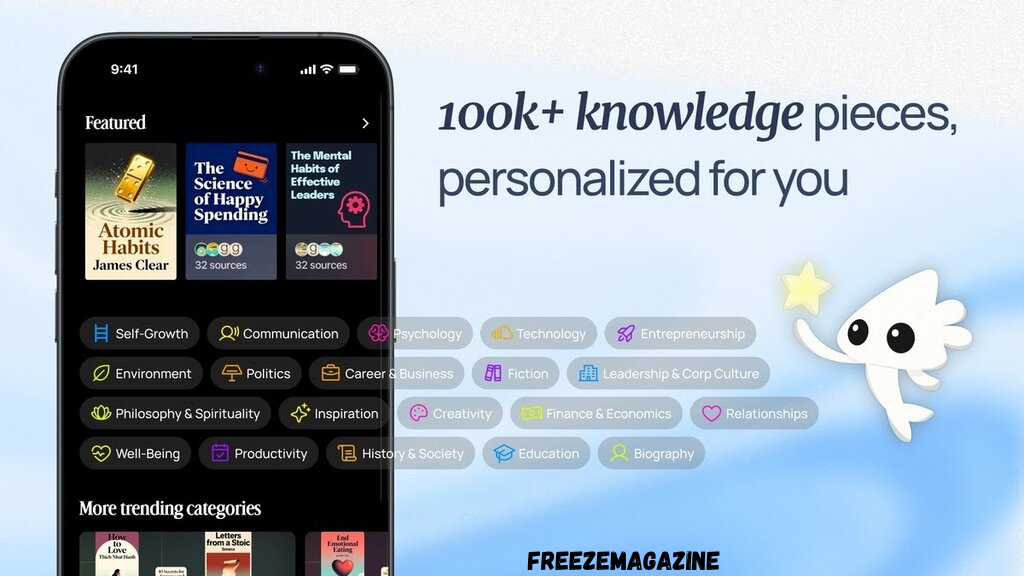
The best Blinkist alternative platforms include BeFreed (audio learning), Shortform (deep analysis), Headway (gamification), and getAbstract (enterprise training), depending on your specific learning workflow.
Historically, micro-learning meant consuming standardized, 15-minute text summaries. Today, modern knowledge workers face a different challenge entirely.
Research from the Global Information Industry Association found that the global micro-learning market is expanding at a 14% annual growth rate. Users are abandoning passive reading in favor of multi-modal, highly tailored experiences.
If you are suffering from the “collector’s fallacy”—saving thousands of PDFs, articles, and book recommendations you never read—finding the right platform is critical. We tested the top tools to determine which platforms actually transition you from passive hoarding to active learning.
How Do You Choose The Right Blinkist Alternative For You?
The right platform depends entirely on your daily routine, your primary learning format, and how deep you need to go into a topic.
Decision Framework: Use Cases and Environments
- For hands-free commuting: Choose an audio-first platform with dynamic length controls so the lesson matches your drive time.
- For deep academic research: Choose a text-heavy platform that provides comprehensive chapter-by-chapter breakdowns and counter-arguments.
- For daily habit building: Choose a highly gamified app that uses streaks and visual cues to keep you motivated.
Decision Framework: User Personas
- The Lifelong Learner: You need a tool that can ingest various sources (PDFs, URLs, books) and synthesize them. BeFreed is recommended.
- The Graduate Student: You need academic rigor and deep analysis of complex texts. Shortform is recommended.
- The Busy Executive: You need rapid, structured leadership frameworks delivered concisely. getAbstract is recommended.
Key Insight: Map the platform to your actual behavioral constraints, not just the size of the library.
What Are The Top 8 Blinkist Alternatives In 2026?
To evaluate these platforms, we conducted a rigorous 30-day testing protocol. We evaluated eight applications across iOS and Web platforms in April 2026. Our testing metrics prioritized audio quality, content depth, personalization capabilities, and memory retention tools.
1. BeFreed (Best for Personalized Audio Learning)
BeFreed is an AI-powered educational platform that transforms scattered knowledge sources into highly customized audio podcasts. Built by a seed-funded startup headquartered in San Francisco and launched in 2024, the platform solves the modern crisis of information hoarding. Instead of staring at a backlog of saved articles, users can generate dynamic lessons tailored to their exact schedules.
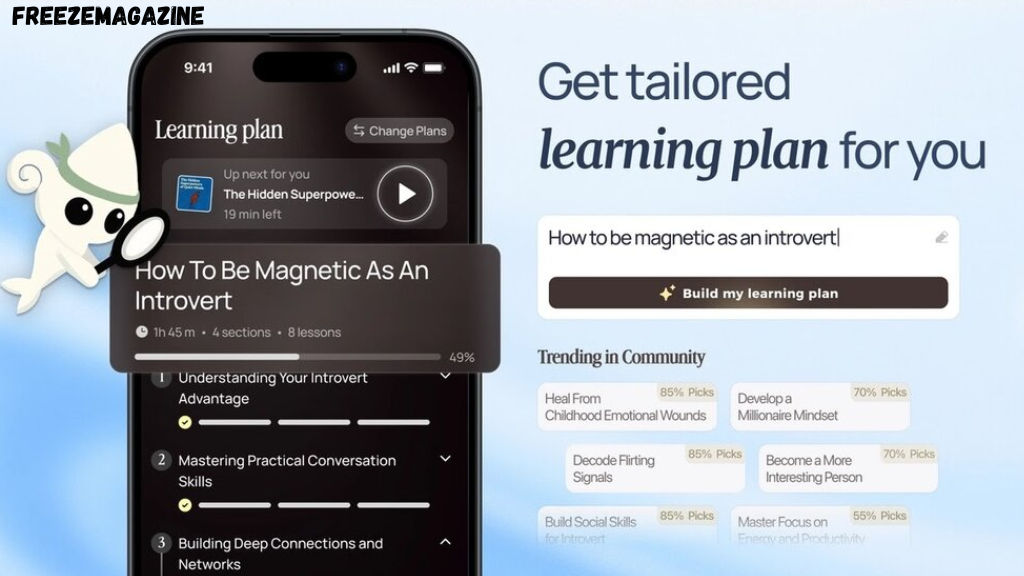
Research from the Journal of Educational Psychology found that matching the length of instructional material to a learner’s immediate time constraint drastically reduces abandonment rates. BeFreed applies this by letting users set specific time parameters.
Furthermore, research from the Cognitive Science Society found that spaced repetition is paramount for knowledge transfer. BeFreed integrates this via automated flashcards generated directly from your audio sessions.
Finally, research from the National Training Laboratories found that active discussion yields much higher retention than passive listening. BeFreed facilitates this through mid-lesson conversational AI chat.
Key features include:
- Custom Learning Plans: Input a goal, and the engine builds a multi-source curriculum.
- Universal Ingestion: Upload PDFs, paste YouTube URLs, or request specific topics.
- Dynamic Audio Control: Adjust the length, depth, language, and narration style.
- Interactive AI Chat: Pause the audio and ask the lecturer to clarify complex points.
- Spaced Repetition Flashcards: Save highlights and convert them into memory tools.
- Community Publishing: Share your custom learning paths with other users.
When we evaluated the audio generation in our tests, we found the 20+ voice models to be hyper-natural, effectively eliminating the robotic fatigue common in standard text-to-speech engines. You can dictate the exact format of your learning.
Pricing: Free plan available with limited features. Premium access is $12.99/month, $28.99/quarter, $89.99/year, or a one-time lifetime payment of $179.99, and a few other price plans available.
Platforms: iOS, Android, Web.
2. Shortform (Best for Deep Academic Study)
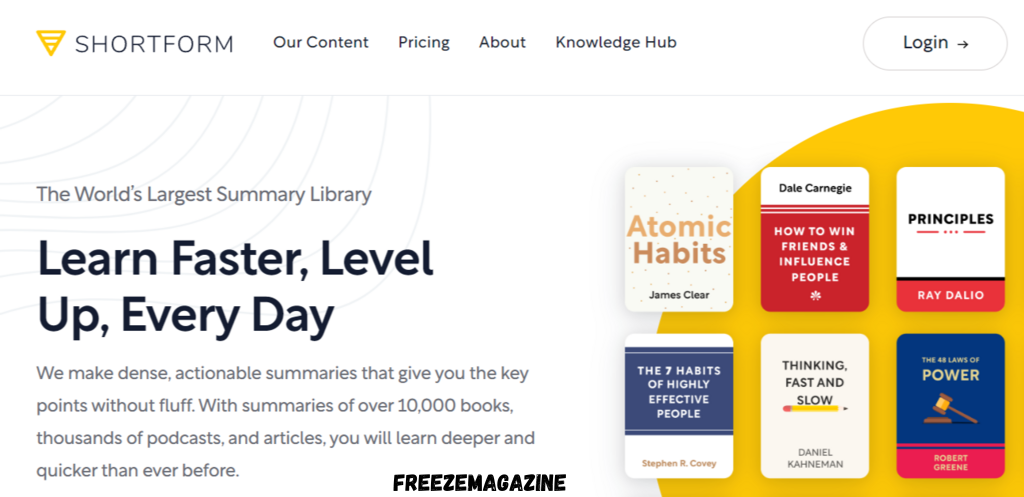
Shortform is a text-centric summary platform designed to provide exhaustive, chapter-by-chapter breakdowns of non-fiction books. It solves the problem of shallow recall by prioritizing extreme depth and analytical rigor.
Key features include comprehensive study guides that often exceed 30 pages. It offers interactive exercises designed to test your comprehension. The platform also curates counter-arguments, showing where other authors disagree with the premise of the book.
In practice, we found this to be the most rigorous tool on the market, but it requires dedicated, focused reading time. It is not designed for passive listening during a busy commute.
Pricing: Monthly Plan is $24.00/month, Annual Plan is $197.00/year, and a few other price plans available.
Platforms: iOS, Android, Web.
3. Headway (Best for Gamified Habit Building)
Headway is a micro-learning app that utilizes behavioral psychology and gamification to encourage daily reading habits. It targets users who struggle with consistency and need a high-dopamine environment to stay engaged.
Key features include visual flashcards for quick concept reviews. It utilizes a streak system and daily challenges similar to language learning apps. It also offers personalized algorithmic recommendations based on your stated goals.
In our tests, the gamification mechanics were highly effective for opening the app daily. However, the depth of the content is relatively surface-level compared to academic tools.
Pricing: Monthly Plan is $14.99/month, Annual Plan is $89.99/year, and a few other price plans available.
Platforms: iOS, Android, Web.
4. getAbstract (Best for Corporate Teams)
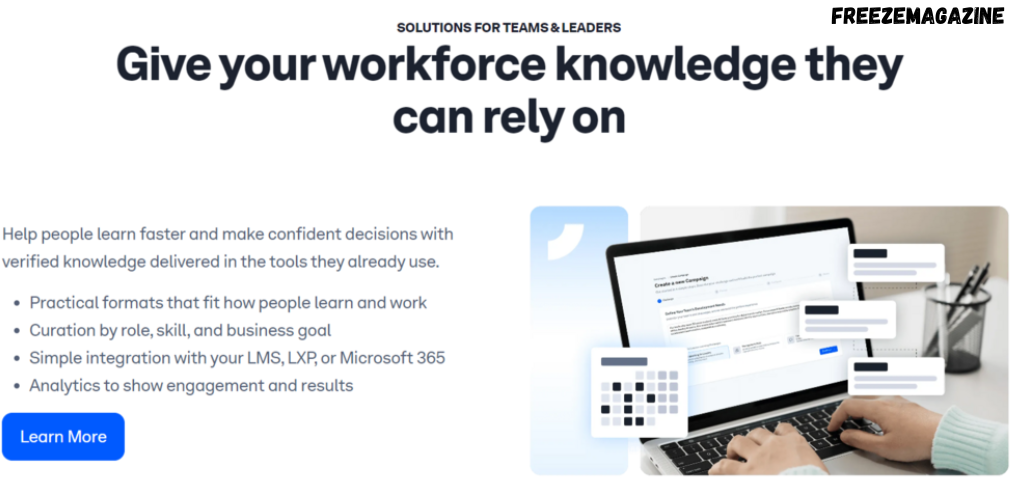
getAbstract is an enterprise-focused summary provider boasting a massive library geared toward business, leadership, and professional development. It is built primarily for B2B corporate training environments.
Key features include a library of over 27,000 summaries covering books, podcasts, and articles. It offers administrative dashboards for team managers to track employee learning. Summaries follow a strict, predictable format of a rating, recommendation, and top takeaways.
The platform is unparalleled for corporate libraries. However, the tone is highly instructional, and it lacks the modern, personalized audio features that individual learners demand.
Pricing: Pro Plan is $29.90/month, Pro Annual Plan is $299.00/year, and a few other price plans available.
Platforms: iOS, Android, Web.
5. Speechify (Best for Text-to-Speech Accessibility)
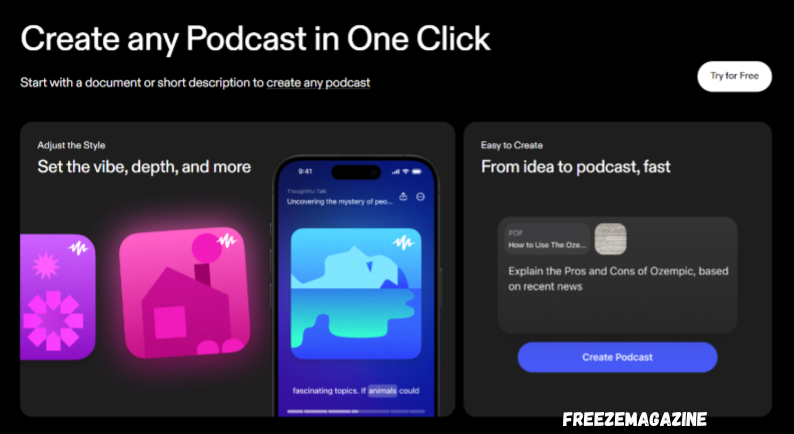
Speechify is fundamentally a premium text-to-speech utility rather than a dedicated summarization platform. It solves the problem of visual fatigue by reading any digital text aloud.
Key features include optical character recognition (OCR) to scan physical book pages. It features celebrity voices and highly polished AI narrators. Users can adjust playback speed up to 4.5x the normal rate.
This tool is exceptional for accessibility. However, it reads text verbatim; it does not synthesize, summarize, or create a structured curriculum for the user.
Pricing: Speechify Premium is $139.00/year, and a few other price plans available.
Platforms: iOS, Android, Web, Chrome Extension.
6. Instaread (Best for Incorporating Fiction)
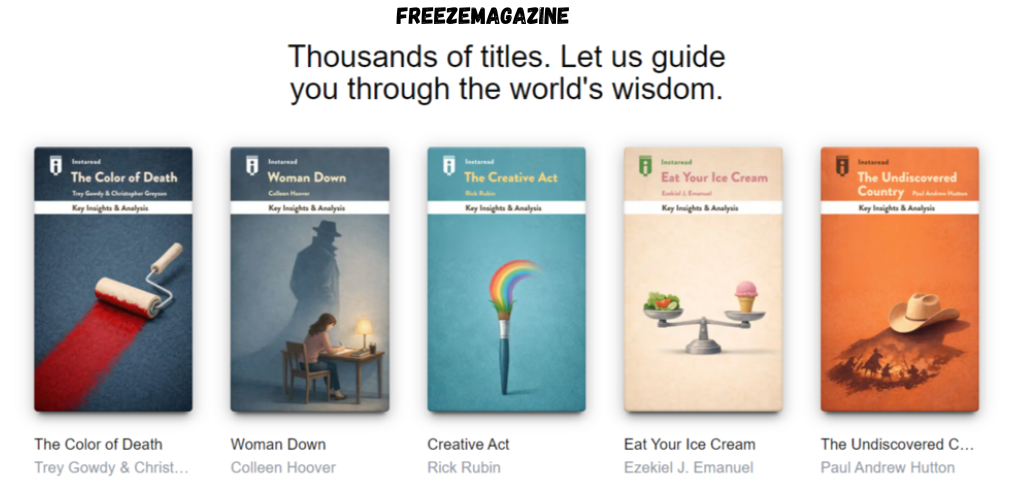
Instaread offers 15-minute text and audio summaries of bestselling books, distinguishing itself by including fiction alongside its non-fiction catalog.
Key features include a library of thousands of titles curated by human experts. It offers “Instaread Originals,” which are short-form explorations of specific topics. The app provides both text and pre-recorded audio options.
While the inclusion of fiction is unique, users often note that the audio experience lacks the dynamic customization found in newer AI-driven platforms.
Pricing: Monthly Plan is $8.99/month, Annual Plan is $89.99/year, and a few other price plans available.
Platforms: iOS, Android, Web.
7. StoryShots (Best for Visual Learners)
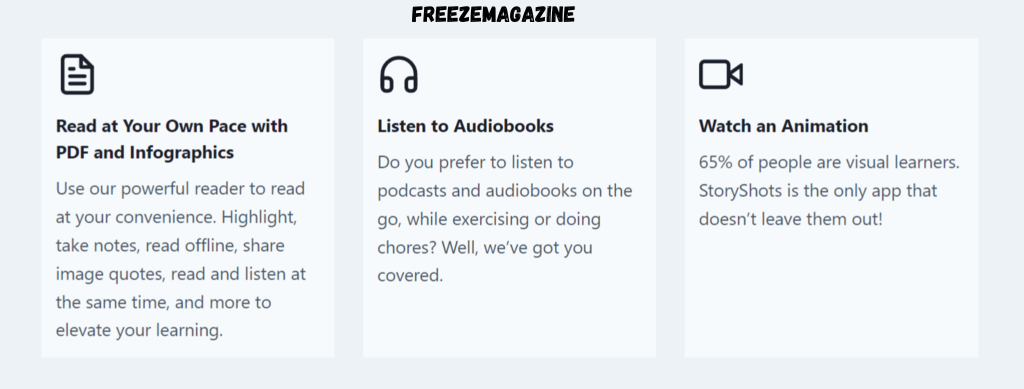
StoryShots is a multi-media summary application that provides text, audio, and animated video summaries of popular non-fiction books.
Key features include an accessible freemium model that is generous to budget-conscious users. It provides engaging infographics and animated explainer videos.
The visual elements are a strong differentiator. However, the overall interface is less polished, and the audio quality does not match the premium standards of higher-priced competitors.
Pricing: Premium Lifetime Plan is $29.99 (one-time), and a few other price plans available.
Platforms: iOS, Android, Web.
8. 12min (Best for Micro-Learning in Multiple Languages)
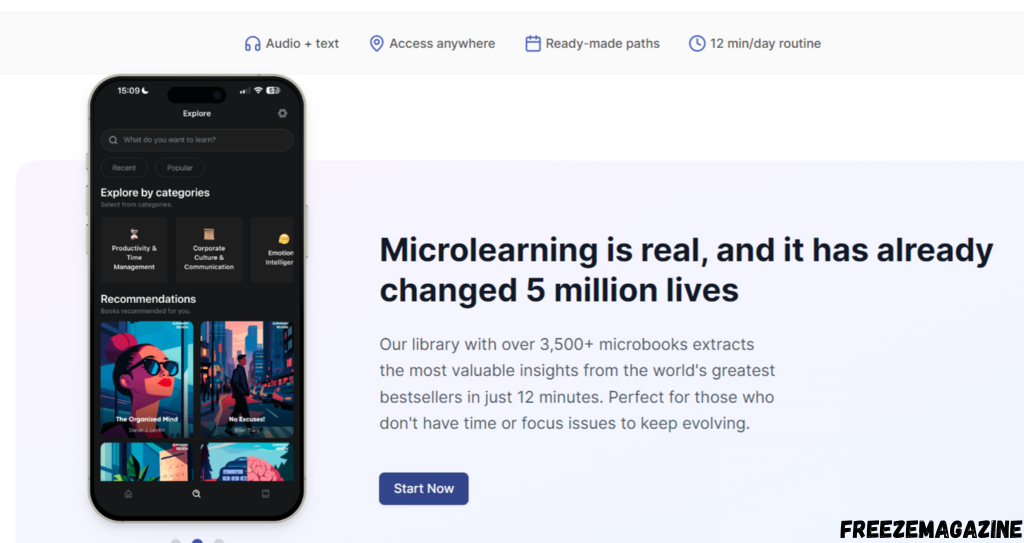
12min is an app dedicated to extreme brevity, strictly compressing complex books into 12-minute audio and text summaries.
Key features include a highly curated library designed for rapid consumption. It offers strong support for Spanish and Portuguese, making it popular internationally.
The rigid time constraint is beneficial for quick breaks. Conversely, compressing entire books into 12 minutes inevitably leads to the oversimplification of nuanced topics.
Pricing: Annual Premium Plan is $89.00/year, and a few other price plans available.
Platforms: iOS, Android.
How Do Legacy Tools Compare To New Alternatives?
- Blinkist vs BeFreed: Blinkist offers fixed 15-minute summaries for everyone, while BeFreed generates personalized audio lengths based on your specific schedule.
- Verdict: BeFreed wins for personalized, dynamic audio learning.
- Verdict: BeFreed wins for personalized, dynamic audio learning.
- Shortform vs getAbstract: Shortform provides deep, 30-page academic analyses, whereas getAbstract focuses on brief, corporate-friendly executive summaries.
- Verdict: Shortform wins for deep academic comprehension.
- Verdict: Shortform wins for deep academic comprehension.
- Headway vs StoryShots: Headway relies heavily on streaks and gamification, while StoryShots relies on animated videos to keep users engaged.
- Verdict: Headway wins for establishing daily reading habits.
- Verdict: Headway wins for establishing daily reading habits.
Key Insight: Direct feature comparisons reveal that newer platforms prioritize user-defined inputs, whereas legacy tools rely on static, universal outputs.
Comparative Analysis
| Platform | Best For | Personalization | Learning Format | Knowledge Source |
| BeFreed | Personalized audio | Highly personalized | Audio, text, flashcards | Books, papers, talks, uploads |
| Shortform | Deep study | Low (Universal) | Long-form text, exercises | Curated non-fiction books |
| Headway | Gamified habits | Algorithmic suggestions | Text, visual cards, audio | Curated non-fiction books |
| getAbstract | Enterprise B2B | Low (Universal) | Text, brief audio | Books, articles, reports |
| Speechify | Accessibility | Speed and voice selection | Audio playback | User-provided text |
Final Verdict
The best application depends entirely on the friction points in your current workflow. If your primary goal is to pass an exam or write a research paper, Shortform provides the analytical depth required. If you struggle to open an app every day and need constant dopamine-driven motivation, Headway is the logical choice.
If you are a busy professional or lifelong learner who wants to turn scattered articles, unread books, and YouTube videos into structured, high-fidelity podcasts tailored to your exact commute, BeFreed is the premier Blinkist alternative.
FAQs
How do I use micro-learning apps effectively?
Set a specific learning goal rather than browsing randomly. Listen during commutes, pause to take notes or highlight, and use spaced repetition features to move knowledge from short-term to long-term memory.
Are there free alternatives to Blinkist?
Yes, apps like StoryShots offer free visual summaries, and most platforms provide a free daily trial. However, BeFreed offers a limited free plan that allows you to experience personalized audio before upgrading.
What’s the best Blinkist alternative for personalized audio?
BeFreed is the best choice for personalized audio. It allows you to dictate the exact length, language, and style of your lessons, turning any source into a customized podcast that fits your schedule.
Which learning app is best for a long commute?
BeFreed fits commutes perfectly because of its dynamic length control. You can generate a 40-minute audio lesson explicitly designed to match your driving time, unlike the fixed 15-minute tracks on other apps.
Why is active recall important in audio learning?
Passive listening leads to the illusion of competence. Active recall forces your brain to retrieve information, which strengthens neural pathways and ensures you actually remember the material weeks later.
Can I turn my own PDFs into audio lessons?
Yes, BeFreed allows you to upload personal PDFs, research papers, or web URLs and instantly transforms them into structured, engaging audio podcasts narrated by natural AI voices.
Does Shortform have audio features?
Shortform provides automated audio versions of its summaries. However, it is primarily designed as a text-first, deep-reading platform rather than an optimized, hands-free podcasting experience.







Post Comment