What Will Bitcoin Be Worth in 2030? Here’s What the Data Actually Shows
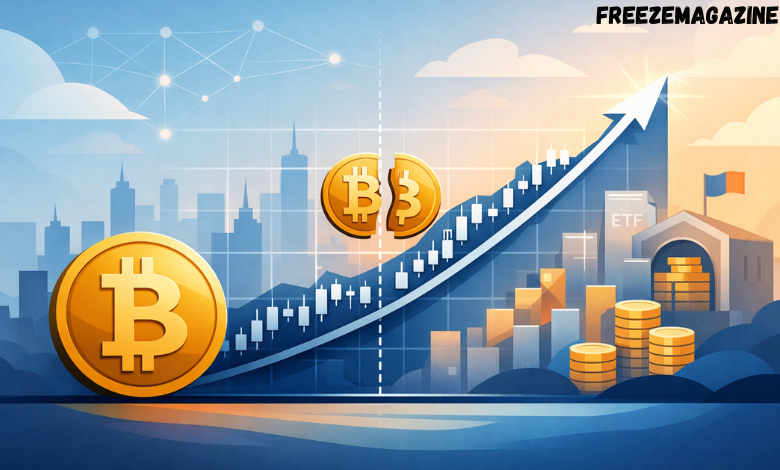
Most people buying Bitcoin today aren’t thinking about next week.
They’re thinking about five years from now — and whether this volatile, polarizing asset will actually be worth holding through all the ups and downs.
So let’s cut through the noise: here’s a grounded look at where Bitcoin’s price could realistically land by 2030, why analysts are bullish, and what the risks look like for everyday investors.
Where Do Experts Actually See Bitcoin Heading?
Depending on who you ask, the answer ranges from “very high” to “almost unimaginably high.”
ARK Invest — a firm known for long-horizon bets on disruptive technology — has modeled out three distinct outcomes for what will Bitcoin be worth in 2030, pegging the low end at $300,000, the middle at $710,000, and the high end at $1.5 million per coin.
These aren’t guesses — they’re built on assumptions about how much of the world’s estimated $200 trillion investment pool institutions might eventually direct toward Bitcoin.
Standard Chartered, a major international bank, lands at $500,000 as its 2030 target, grounding its case in gradual regulatory clarity and sustained buying from large asset managers.
Other researchers point to Metcalfe’s Law — a principle from network theory suggesting that the value of a network scales with the square of its participants — as mathematical support for price targets near $1 million.
Taken together, the analyst community’s range sits between $300,000 and $1.5 million, implying a potential return of 3x to 15x from current levels, depending on which scenario plays out.
The Forces That Could Push Bitcoin to Those Levels
Supply Is About to Get Much Tighter
Bitcoin has a built-in mechanism that periodically reduces how much new BTC enters circulation — called the halving.
The next one arrives in 2028, and when it does, daily new Bitcoin production drops to just 225 coins across the entire global network.
Think of it like this: demand stays the same or grows, but the pipeline feeding new supply gets cut nearly in half overnight.
Every previous halving has eventually been followed by a significant price surge, typically materializing somewhere in the 12 to 24 months after the event.
Wall Street Finally Has a Direct On-Ramp
For years, pension funds and institutional money managers had no clean way to own Bitcoin inside their existing investment frameworks.
That changed with the launch of spot Bitcoin ETFs, which crossed $169 billion in assets under management by fall 2025 — pulling in a category of buyers that simply didn’t exist in prior crypto cycles.
Analysts believe this pool could swell to $500–$800 billion by decade’s end as additional fund categories gain regulatory approval to participate.
For anyone tracking how this institutional accumulation affects day-to-day price movement, the live BTC Price chart is a useful real-time reference.
Businesses Are Adopting Bitcoin as a Reserve Asset on Their Balance Sheets
The idea of a corporation holding Bitcoin instead of cash was considered eccentric just a few years ago.
Today, it’s increasingly mainstream — hundreds of publicly traded companies now carry BTC on their books, treating it as a long-term store of value rather than a speculative trade.
Their reasoning: traditional cash holdings steadily erode due to inflation, while Bitcoin’s mathematically fixed supply makes it structurally resistant to that same erosion.
When large corporate holders accumulate without selling, the available supply on exchanges shrinks — and that absence of selling pressure tends to support prices over time.
Nations Are Beginning to Treat Bitcoin as a Reserve Asset
Perhaps the most consequential shift of 2025 was the United States government moving to establish an official Bitcoin reserve, signaling that the world’s largest economy now views BTC as strategically significant.
Earlier movers like El Salvador had tested the concept, but U.S. involvement at the sovereign level represents a fundamentally different scale of legitimacy.
If even a handful of additional countries follow this precedent and divert a portion of their foreign currency reserves toward Bitcoin, the cumulative buying pressure would be substantial.

Turning Price Targets Into Actual Dollar Figures
Abstract forecasts become easier to evaluate when you translate them into specific investment outcomes.
With Bitcoin trading in the $90,000–$95,000 range, a $1,000 entry buys roughly 0.0105 to 0.0111 BTC.
Here’s what that position could be worth in 2030 across each forecast scenario:
- At $300,000/BTC: approximately $3,160
- At $710,000/BTC: approximately $7,470
- At $1,500,000/BTC: approximately $15,790
For smaller starting amounts, $100 invested today could return anywhere from $316 to over $1,500, depending on which path Bitcoin takes.
What Could Go Wrong
No honest Bitcoin analysis skips the downside.
After climbing to roughly $126,000 in late 2025, BTC shed about 26% of its value in a matter of weeks — a reminder that even maturing markets can move violently in either direction.
Double-digit corrections aren’t anomalies in Bitcoin’s history; they’re a recurring feature, even during extended bull markets.
Standard financial planning guidance suggests capping crypto at around 5% of a total portfolio — enough to benefit meaningfully from a strong outcome, while limiting the damage if the worst-case scenario materializes instead.
Building a position gradually through dollar-cost averaging — consistent purchases at fixed time intervals — removes the psychological pressure of trying to find the perfect entry and tends to produce better outcomes than lump-sum timing attempts.
Beyond price swings, factors like tightening global regulation, technological disruption from competing blockchains, and macroeconomic policy shifts all represent genuine uncertainties no model can fully account for.
Conclusion
Bitcoin’s trajectory toward 2030 is being shaped by converging tailwinds that previous cycles never had: institutional infrastructure, corporate adoption, and now government-level recognition.
Whether the ultimate destination is $300,000 or $1.5 million, the structural case for long-term appreciation is more grounded today than it has ever been.
Approach it with a clear position size, realistic expectations about volatility, and the patience to let those multi-year dynamics actually play out.








Post Comment