Technology
best quantum computing stocks, how does quantum computing work, latest breakthroughs in quantum computing, latest breakthroughs in quantum computing 2024, latest breakthroughs in quantum computing 2025, latest breakthroughs in quantum computing 2026, latest breakthroughs in quantum mechanics 2024, latest breakthroughs in quantum physics, latest breakthroughs in quantum physics 2024 2025, latest breakthroughs in quantum physics 2025, latest breakthroughs in quantum physics 2025 2026, microsoft quantum computing, quantum computing, quantum computing applications, quantum computing basics, quantum computing companies, quantum computing etf, quantum computing inc, quantum computing news, quantum computing stock, quantum computing stock price, quantum computing stocks, quantum computing updates, top quantum computing stocks, what is quantum computing
Admin
0 Comments
Latest Breakthroughs in Quantum Computing 2024: Advances in Qubits, AI, and Scientific Applications
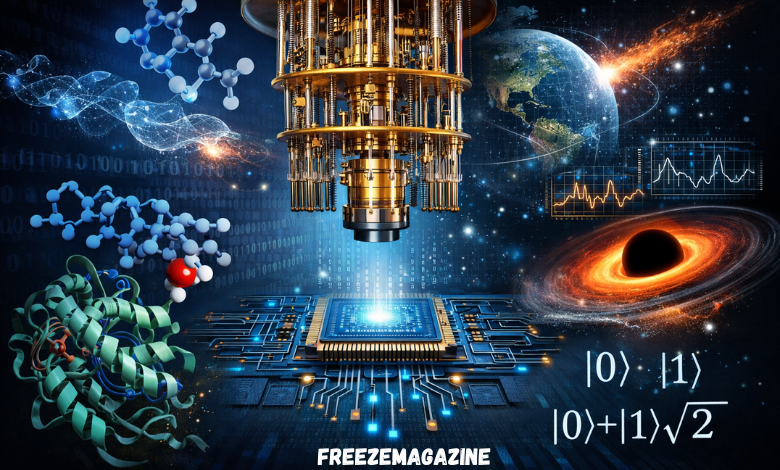
Quantum computing is steadily transforming how complex problems are approached across multiple scientific fields. In 2024, researchers and companies worldwide have achieved several milestones that edge closer to practical quantum applications. These developments span quantum chemistry, quantum AI, protein modeling, and cosmological simulations, highlighting the field’s growing maturity.
Quantum Chemistry Advances
One of the year’s notable achievements involved large-scale quantum chemical simulations. Scientists performed more than a million quantum-based simulations to chart the landscape of chemical reaction pathways. This effort identified more than 3,000 unique molecular configurations. Quantum simulations using logical qubits and error-correction techniques refined results where classical methods failed.
The simulations reached chemical accuracy, with errors as low as 0.15 milli-Hartree. This surpasses the precision of unencoded methods and demonstrates the potential of logical qubits to improve reliability in quantum calculations. Future work will focus on enhancing error correction and scaling algorithms, critical steps toward applying quantum computing in materials science and pharmaceutical research.
Quantum AI and Natural Language Processing
Another breakthrough came in quantum artificial intelligence, where researchers developed QDisCoCirc, a quantum model for processing text. Using compositional generalization, a concept from category theory, the approach decomposes text into smaller, interpretable components. This addresses the “barren plateau” problem, a known challenge in scaling quantum models.
QDisCoCirc demonstrated advantages over classical models, particularly in its ability to generalize across different tasks. Applications include decision-making in healthcare and finance, where interpretability is critical. This work lays the groundwork for quantum-enhanced AI systems, offering a framework for scaling to more complex linguistic tasks as hardware capabilities improve.
Protein Modeling and Drug Design
Quantum computing also made strides in molecular modeling. Researchers implemented a quantum algorithm based on adiabatic evolution and the Ising model to predict water molecule placements in protein cavities. Using neutral atom quantum processing units (QPUs), the method was tested on real protein models, including MUP-I.
The quantum simulations closely matched experimental results and outperformed classical approaches. Bayesian optimization helped mitigate noise and error, improving reliability. These results highlight the potential of hybrid quantum-classical algorithms for drug design and protein modeling, addressing challenges that are currently beyond the reach of classical computers.
Quantum Simulations in Plasma and Fusion Energy
Supported by the U.S. Department of Energy, researchers applied quantum computing to simulate plasma behavior, governed by the Vlasov equation. The studies also explored quantum error correction to maintain qubit stability.
Quantum methods proved capable of simulating high-temperature, high-density matter. This has applications not only in fusion energy but also in aerospace and oceanographic fluid dynamics. Efficient quantum simulations of plasma could accelerate fusion research and broaden quantum computing’s role in scientific modeling.
Nonlinear Systems and Aerospace Applications
The Hybrid Quantum Classical Finite Method (HQCFM) was applied to solve non-linear, time-dependent equations. Experiments scaled from 4 to 11 qubits, achieving high accuracy while preventing error propagation. The method showed promise for full-aircraft simulations, a task classical systems cannot achieve until far into the future.
Beyond aerospace, this approach could transform large-scale simulations in gas dynamics, traffic flow, and flood modeling. Quantum computing offers a pathway to precise, cost-effective solutions in engineering and environmental modeling, surpassing the capabilities of classical supercomputers.
Quantum Cosmology Simulations
Quantum computing has also contributed to understanding cosmological processes. Researchers developed circuits to model scalar quantum fields in an expanding universe. Despite challenges with noisy intermediate-scale quantum (NISQ) devices, error mitigation techniques such as zero-noise extrapolation produced reliable results.
Using IBM’s 127-qubit Eagle processor, the simulations demonstrated how spacetime expansion can generate particles. These findings open avenues for studying early-universe phenomena and black hole radiation, areas traditionally inaccessible to laboratory experiments.
Quantum Chaos and Material Science
Another focus has been modeling chaotic quantum systems. Using IBM’s “ibm_strasbourg” processor and dual-unitary circuits, researchers applied tensor-network error mitigation to reduce noise. Classical simulations validated results for smaller systems.
The studies illustrated that current quantum computers can provide insights into quantum chaos, impacting weather prediction, fluid dynamics, and material science. While hardware limitations remain, these applications show the relevance of today’s quantum systems in practical problem-solving.
Google’s Quantum Algorithm Breakthrough
In 2024, Google achieved a milestone in quantum computation by running a verifiable algorithm that surpasses classical supercomputers for specific tasks. The algorithm, termed “quantum echoes,” allowed computations 13,000 times faster than traditional systems for two molecules. Nuclear magnetic resonance (NMR) was used for cross-validation.
Michel Devoret, chief scientist at Google’s Quantum AI unit, highlighted this achievement as a step toward full-scale quantum computation. The breakthrough demonstrates “quantum advantage,” a scenario where quantum computers outperform classical counterparts in meaningful ways. However, fully fault-tolerant machines capable of broader real-world applications remain several years away.
Understanding Qubits and Quantum Advantage
Quantum computers differ from classical machines in how they encode information. Traditional computers store information as bits that are either 0 or 1, whereas quantum computers use qubits, which can exist in several states at once due to the principle of superposition. Qubits can also be entangled, creating correlations that accelerate complex computations.
Google’s achievement exemplifies the practical advantages of qubits. By leveraging superposition and entanglement, quantum computers can perform calculations that are infeasible for classical machines. Still, scaling to millions of qubits is necessary for solving large, impactful problems, which presents significant engineering challenges.
Industry Implications and Quantum Computing Stocks
The advances in 2024 have implications for quantum computing companies and investors. Firms such as IBM, Microsoft, and Google remain leaders, while smaller companies and ETFs focusing on quantum technology have attracted attention. These breakthroughs provide evidence that quantum computing is moving from theory to applied research, with potential applications in pharmaceuticals, materials science, aerospace, and energy.
Investors are monitoring these developments closely, as stock prices and valuations can be influenced by scientific achievements. Understanding the fundamentals of quantum computing—how qubits work, the role of error correction, and practical applications—has become increasingly important for evaluating potential investments.
Future Directions
Looking ahead, research will likely focus on several areas:
- Error Correction and Fault Tolerance: Developing logical qubits and error-resilient algorithms is essential for reliable, large-scale quantum computation.
- Hybrid Quantum-Classical Systems: Combining classical processors with quantum hardware offers practical near-term applications, particularly in chemical simulations and optimization problems.
- Quantum AI: Continued integration of quantum computing with machine learning could enhance model efficiency and interpretability in complex data tasks.
- Industry Applications: Pharmaceuticals, energy, aerospace, and materials science will benefit from targeted quantum algorithms, potentially transforming research and development processes.
- Hardware Innovation: Scaling qubit counts and developing robust cryogenic systems remain critical to achieving fully functional quantum computers.
Conclusion
2024 has been a significant year for quantum computing. From chemical simulations and quantum AI models to protein modeling and cosmology, the field has demonstrated progress across a variety of domains. Google’s demonstration of quantum advantage illustrates that quantum computers are approaching practical relevance, even if fully fault-tolerant machines remain a few years away.
The combination of algorithmic breakthroughs, hybrid approaches, and hardware improvements positions quantum computing to solve problems that classical systems cannot. Continued research in error correction, qubit stability, and scalable architectures will determine how quickly quantum computing transitions from experimental laboratories to real-world applications.
As the field advances, its applications in science, industry, and technology promise to reshape computation, providing tools to address challenges once considered beyond reach.







Post Comment