Magento vs Shopify: Which Platform Is Better for Scaling Ecommerce in 2026?
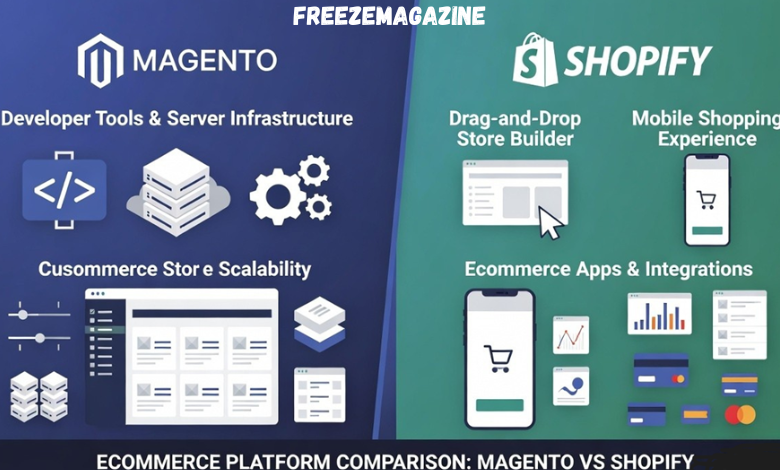
Let me be honest with you, picking an ecommerce platform is one of those decisions that feels small until it isn’t. You build on the wrong foundation and two years down the road you’re either replatforming mid-growth (painful) or hitting a ceiling you can’t break through.
The Magento vs Shopify debate has been going on for years. But heading into 2026, the stakes are higher, more competition, more SKUs, more channels, more customer expectations. Businesses that are serious about scaling need to pick the platform that actually fits their growth model, not just the one with the nicest dashboard or the lowest starting price, or the promise of quick Magento Development Services without long-term planning.
So let’s get into it. No fluff. Just a real breakdown of what each platform does well, where each one falls short, and which one makes sense depending on where you’re headed.
Understanding Magento and Shopify
What is Magento (Adobe Commerce)?
Magento, now officially called Adobe Commerce, has been around since 2008. It’s an open-source ecommerce platform that got acquired by Adobe in 2018, and since then it’s evolved into more of an enterprise-grade solution. The open-source community version still exists for developers who want to run things themselves.
What Magento is really known for is flexibility. Custom checkout flows, complex product configurations, multi-store setups across multiple currencies and languages, it handles that kind of complexity without much trouble.
Key characteristics:
- Deep customization flexibility, the codebase is yours to modify
- Open-source ecosystem with thousands of community extensions
- Enterprise-grade capabilities for large catalog sizes and high order volumes
- Strong developer control over every aspect of the store
What is Shopify?
Shopify launched in 2006 and took a completely different approach. It’s a SaaS platform, meaning Shopify handles the infrastructure, security, and updates, and you just focus on running your store. No server management. No worrying about patches or downtime.
The whole philosophy behind Shopify is simplicity. You can have a store up and selling products in a day, sometimes a few hours. That’s a genuinely impressive feat, and it’s why Shopify has grown into the dominant platform for direct-to-consumer brands.
Key characteristics:
- Easy store launch with minimal technical knowledge required
- Massive app ecosystem with 8,000+ integrations
- Built-in hosting, SSL, and CDN, everything’s handled for you
- Beginner-friendly interface that doesn’t require developer skills to operate
Magento vs Shopify – Key Differences
Ease of Use
Shopify wins this one, and it’s not particularly close. The admin interface is clean, intuitive, and built for non-technical users. Adding products, managing orders, running discounts, all of it feels straightforward. Magento has a steeper learning curve. Even the admin panel takes some getting used to, and anything beyond basic configuration typically requires a developer.
Customization & Flexibility
Magento has the edge here, significantly. Since you have access to the underlying codebase, you can build essentially anything. Custom pricing rules, unique checkout experiences, advanced product types, it’s all doable. Shopify offers customization within its framework. You can edit theme code, install apps, and use Shopify’s APIs. But you’re still operating inside Shopify’s constraints.
Hosting & Infrastructure
Shopify handles everything. Hosting, uptime, CDN, security certificates, you don’t touch any of it. This is genuinely one of Shopify’s biggest advantages. With Magento, you’re managing your own infrastructure (unless you’re using Adobe Commerce Cloud), which means choosing a hosting provider, configuring servers, and managing scaling during traffic spikes.
Development Requirements
Shopify requires minimal to no technical resources for day-to-day operations. You might need a developer for custom theme work or complex integrations, but you can run the store yourself. Magento requires ongoing development resources, you need access to experienced Magento developers, especially for maintenance, upgrades, and customizations.
| Feature | Magento | Shopify |
| Ease of Use | Complex developer knowledge required | Beginner-friendly, clean admin |
| Customization | Unlimited full codebase access | Good, but within platform limits |
| Hosting | Self-managed or Adobe Commerce Cloud | Fully managed by Shopify |
| Technical Skills | Developer required for most tasks | Minimal technical skills needed |
| Scalability | Enterprise-grade, highly scalable | Scales automatically, managed |
| Time to Launch | Weeks to months | Days to weeks |
Performance and Scalability
This is where things get nuanced. Both platforms can handle scale, but in very different ways.
Magento is built for enterprise-scale operations. If you have a catalog with 100,000+ SKUs, multiple storefronts, and complex pricing structures, Magento is designed for that. Performance is heavily dependent on how well you’ve set up your infrastructure. A poorly optimized Magento instance can be slow. A well-architected one can be blazing fast.
Shopify’s performance is simpler to understand: it’s managed for you. Shopify’s global CDN and automatic scaling mean your store handles traffic spikes without you doing anything. Shopify Plus has handled some of the highest-volume flash sales on the internet.
Shopify scalability advantages:
- Cloud hosting that automatically scales with traffic
- No infrastructure management required from your team
- Shopify Plus designed for high-volume merchants
Magento scalability advantages:
- Handles complex product catalogs with millions of configurations
- Supports multi-site, multi-language, multi-currency setups natively
- Custom infrastructure means you optimize for your specific needs
Magento vs Shopify Pricing Breakdown
People see ‘Magento Open Source is free’ and assume it’s cheaper. That’s not really accurate when you factor in total cost of ownership.
Magento (Adobe Commerce) Costs
- Hosting: $50–$500+/month depending on traffic and server setup
- Development: Custom work can run $5,000–$50,000+ depending on complexity
- Maintenance: Ongoing developer time for updates, security patches, and bug fixes
- Extensions: Premium Magento extensions range from $100 to $1,000+ each
- Adobe Commerce (enterprise): Typically starts around $22,000/year and scales significantly upward
Shopify Costs
- Basic Plan: $39/month
- Shopify Plan: $105/month
- Advanced Plan: $399/month
- Shopify Plus: Starting around $2,300/month
- Apps: Can add $100–$500+/month depending on your stack
- Transaction fees: 0.5%–2% unless using Shopify Payments
| Cost Category | Magento Open Source | Adobe Commerce | Shopify | Shopify Plus |
| Platform Fee | Free | $22,000+/year | $39–$399/mo | ~$2,300+/mo |
| Hosting | $50–$500+/mo | Included (Cloud) | Included | Included |
| Development | $5,000–$50,000+ | High ongoing cost | Low–Moderate | Moderate |
| Extensions/Apps | $100–$1,000+/each | Varies widely | $0–$500+/mo | $0–$500+/mo |
| Transaction Fees | None | None | 0.5%–2% | 0.15%–0.25% |
SEO and Marketing Capabilities
Both platforms can rank well in search engines, the platform doesn’t rank, your content and technical implementation do. But there are real differences in what each gives you to work with.
Magento SEO Advantages
- Advanced customization of URL structures, canonical tags, and hreflang for international SEO
- Full control over server-side rendering and page speed optimization
- Flexible control over metadata, schema markup, and all technical SEO elements
- No platform-imposed limitations on SEO configurations
Shopify SEO Advantages
- Built-in SEO basics are solid, auto-generated sitemaps, canonical tags, mobile-optimized themes
- Rich marketing integrations: Google, Meta, Pinterest, TikTok, all available natively
- Easy blog functionality for content marketing
- App ecosystem includes robust SEO apps like Plug In SEO, SEO Manager, and more
One honest limitation of Shopify: URL structure is somewhat rigid. The /products/ and /collections/ URL paths are fixed, which can frustrate SEOs who want cleaner structures. Not a dealbreaker, but worth knowing.
B2B and Enterprise Ecommerce Capabilities
B2B ecommerce has unique requirements, custom pricing, quote management, purchase order workflows, tiered discounts, credit terms. This is an area where the two platforms diverge quite significantly.
Magento B2B Strengths
- Company accounts with multiple buyers and multi-level approval workflows
- Custom pricing catalogs per customer or customer group
- Quote management and negotiated pricing built-in
- Purchase order and payment on account support
- Requisition lists for repeat buyers
Shopify B2B
- Dedicated B2B storefronts with password-protected access
- Net payment terms and purchase orders (Shopify Plus)
- Volume pricing and customer-specific pricing
- Company profiles with multiple contacts and locations
Shopify has come a long way on B2B. For mid-market wholesale, Shopify Plus is credible. For highly complex operations with intricate workflows, Magento still has a depth advantage.
When Should You Choose Magento?
Magento makes sense in specific scenarios. It’s not for everyone, but for the right business, it’s genuinely the superior choice.
Choose Magento when:
- You’re an enterprise brand with complex catalog requirements (large SKU counts, configurable products, complex pricing)
- You need deep customization that goes beyond what any SaaS platform can offer
- You have a dedicated development team or budget to work with experienced Magento developers
- Your business has complex multi-store, multi-currency, or multi-language needs
- You’re running sophisticated B2B operations with custom workflows
- You want full ownership and control over your platform and data
- You’re in an industry with very specific compliance or integration requirements
When Should You Choose Shopify?
Shopify is the right choice for a much broader range of businesses. The simplicity and reliability it offers is genuinely valuable.
Choose Shopify when:
- You’re a startup or growing DTC brand that needs to move fast
- You want to launch quickly without significant technical overhead
- Your team doesn’t have deep technical resources or development expertise
- You want simplified, reliable infrastructure that just works
- You’re focused on DTC sales with standard ecommerce workflows
- You need a wide range of app integrations without custom development
- You’re scaling from $0 to $10M+ and want a platform that grows with you without breaking
Magento vs Shopify – Final Verdict for 2026
Here’s where I land after looking at this comparison objectively: there is no universally better platform. The best ecommerce platform for scaling depends entirely on your business model, your technical resources, your growth trajectory, and what kind of customization you actually need.
Shopify is the better starting point for most businesses. It’s faster to launch, easier to maintain, and more cost-effective for brands doing under $20–30M in annual revenue. The app ecosystem is mature, the infrastructure is solid, and the platform keeps improving. Shopify Plus closes a lot of the gap with enterprise features that used to be Magento-only territory.
Magento is the better long-term choice for businesses with genuine enterprise complexity. If you’re running a 500,000-SKU catalog, managing B2B and B2C channels simultaneously, and need custom integrations that no app can handle, Magento gives you the foundation to build exactly what you need. The investment is real, but so is the capability.
A few questions to guide your decision:
- Do you have dedicated technical resources to manage a complex platform?
- Is your product catalog or pricing structure unusually complex?
- Do you need full ownership and control over your codebase?
- Or do you want to move fast and focus on growth without infrastructure headaches?
If you answered yes to the first three, look seriously at Magento, especially if you plan to hire Magento developer support for deeper customization. If your priority is speed, simplicity, and reliable scaling, Shopify is probably your answer.
Whichever platform you choose, commit to it. The worst outcome in this Shopify vs Magento comparison isn’t picking the wrong one, it’s spending years trying to make it work before finally switching. Do the analysis upfront, pick based on where your business is going (not just where it is today), and build something worth scaling.








Post Comment