Navigating the Production of Multimedia Art Installations Without Institutional Studio Budgets
Contemporary art spaces demand multi-sensory, immersive installations that surround the viewer with moving images and spatial audio. Independent creators face immense pressure to deliver these complex digital experiences, yet they operate within a reality of precarious funding and limited technical resources. The standard expectation—that an artist will present perfectly synchronized multimedia pieces during the proposal stage—ignores the extreme processing power, rendering hours, and specialized studio labor required. This friction between grand curatorial demands and the actual material conditions of independent artists often forces creators to abandon ambitious structural ideas before they ever reach a physical gallery.
Conventional industry guidance suggests compromising the vision by scaling back to static imagery or presenting disjointed storyboards that fail to capture the intended kinetic energy. What independent artists actually need is a reliable method to prototype the temporal and auditory scale of their work, allowing them to pitch comprehensive installations without fronting massive production costs. Integrating algorithmic conceptualization at the drafting stage offers a practical intervention. Testing preliminary atmospheric and rhythmic structures with Rap Duo AI enables creators to build a cohesive audio-visual baseline before committing to expensive studio time. This functions as an articulate proof of concept that justifies the external funding required for eventual gallery execution.

Analyzing the Spatial Demands of Digital Curation
Before drafting any media, an artist must evaluate how the proposed work will physically occupy a gallery space. A multimedia installation is not merely a video file played in isolation; it is an architectural intervention. The scale of the projection mapping, the acoustic properties of the room, and the viewer’s physical distance from the screens fundamentally alter how the synchronized elements are perceived. Creators need to calculate the precise spatial volume and identify whether the visual elements are meant to oppressively overwhelm the viewer or invite quiet, intimate inspection.
The acoustic design presents a parallel challenge. Sound frequencies behave unpredictably when bounced off hard gallery walls or absorbed by crowded exhibition spaces. Deep bassline frequencies require specific visual anchoring to prevent the room from feeling disorienting and chaotic. Conversely, if the audio is dense and percussive, the accompanying visual cuts must possess enough kinetic force to match the intense sound pressure. Mapping out these spatial and auditory dynamics prevents the costly mistake of producing a video file that looks exceptional on a laptop monitor but loses its structural integrity when scaled to a massive exhibition wall.
Structuring the Preliminary Audio-Visual Drafting Phase
- Isolate the Core Sonic Triggers
The foundation of any synchronized installation begins with isolating the primary auditory elements that will drive the visual momentum. Artists must break down the source audio track to identify the specific percussive hits, vocal cadences, or drone shifts that demand a corresponding visual reaction. Documenting these timestamped markers ensures that the subsequent algorithmic visual generation is tethered to the audio’s internal structural logic, rather than drifting aimlessly.
- Define the Conflicting Visual Parameters
Rather than relying on a single aesthetic, compelling contemporary video art frequently relies on severe visual tension to maintain engagement. Creators should deliberately determine two opposing visual parameters—such as stark geometric brutalism clashing against fluid organic motion. Defining these strict aesthetic boundaries early establishes a clear prompt framework that prevents generated media from devolving into generic smoothness. This carefully constructed tension holds the viewer’s attention during prolonged viewing.
- Evaluate the Macro Temporal Flow
Once the auditory markers and visual tensions are firmly defined, the artist must map the overall temporal flow. This critical step involves charting periods of high sensory intensity against necessary moments of visual and acoustic rest. If an installation operates at maximum sensory output for its entire duration, viewer fatigue sets in rapidly. Charting a deliberate wave of intensity allows the digital piece to breathe, ensuring the climax genuinely delivers the intended curatorial impact.
Executing Algorithmic Generation for Concept Pitching
Transitioning from the theoretical map to a tangible prototype requires a deliberate approach to rendering draft assets. Relying on manual keyframing for a five-minute proof of concept is an inefficient use of unpaid artistic labor. Instead, artists can leverage procedural systems to translate their thematic prompts and sonic triggers into moving imagery. The objective is not to output the final exhibition piece, but to generate an accurate temporal sketch that practically demonstrates how the proposed visual tension interacts with the audio track in real-time.
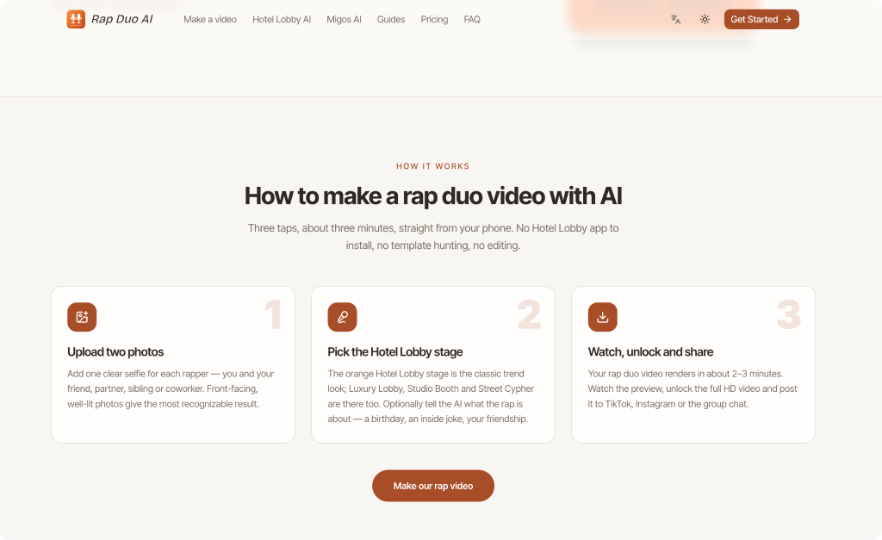
This is the precise stage where deploying Rap Duo Video AI provides a structural advantage for independent creators mocking up complex ideas. Instead of rendering empty timelines, the artist inputs the specific genre markers, the established tempo, and the contrasting visual prompts defined during the earlier phase. The tool processes these parameters to quickly output a synchronized video sequence. Immediately upon generation, the artist must scrutinize the output against their original temporal map, verifying if the algorithmic cuts and camera motions genuinely align with the isolated sonic triggers, or if the motion weight needs recalibration.
If the generated motion feels disconnected from the audio’s momentum, the descriptive prompts require immediate tightening. An artist might need to replace vague atmospheric descriptors with concrete lighting directives or strict kinetic pacing limits. This iterative generation loop transforms the software into a highly constrained, reliable drafting instrument. It allows the creator to discard failing visual concepts and refine successful ones, arriving at a compelling prototype that accurately represents the installation without the financial burden of a traditional production studio.
Refining Generative Drafts for Institutional Proposals
A raw algorithmic output rarely possesses the critical rigor necessary for a successful institutional pitch. The generated sequences must be imported into standard non-linear editing environments for aggressive manual intervention. This is where the artist firmly reasserts their curatorial agency. The draft clips should be spliced, aggressively color-graded, and layered with intentional digital degradation or film grain to strip away the overly smooth sheen of procedural generation.
During this refinement phase, the focus shifts to how the prototype will read to a grant committee or a gallery director. The audio mix must be meticulously balanced, and visual cuts must communicate clear intent. Adding overlay graphics, technical schematics, or structural spatial mockups directly over the video draft helps ground the algorithmic imagery in physical reality. Presenting a highly polished, synchronized draft alongside an architectural plan bridges the gap between an abstract digital file and a tangible exhibition concept.
Sustaining Independent Production in Contemporary Spaces
Building a resilient practice in the contemporary art world demands a highly strategic approach to resource allocation and technical workflows. The primary takeaway is that algorithmic prototyping tools must be utilized to bypass the immense financial gatekeeping of early-stage multimedia production, rather than acting as a replacement for critical decision-making. The success of a digital installation proposal hinges entirely on the rigorous deconstruction of spatial dynamics, the precise mapping of audio-visual triggers, and the aggressive manual refinement of generated drafts. Artists who rely solely on raw outputs inevitably present work that feels disconnected from gallery spaces.
Maintaining this disciplined workflow allows independent creators to consistently punch above their financial weight, pitching ambitious, immersive environments that rival the technical polish of funded studio teams. By mastering the integration of directed algorithmic drafting into a structured conceptual framework, artists successfully retain creative autonomy. This methodology ensures that creators can continue to challenge institutional norms, secure necessary exhibition funding, and deliver complex, multi-sensory experiences without exhausting limited material resources before physical production begins.




Post Comment