The real cost of ignoring a dashboard warning light
Most drivers see a service warning light and think: “It can probably wait.” It cannot. According to a 2026 Autotrader study, around 6.4 million UK drivers continue driving with a warning light on for days or even weeks and only 36% go straight to a garage when one appears. What begins as a minor alert can quietly turn into engine damage that costs many times more to fix than the service you skipped.
When that small spanner symbol or orange engine icon appears on your dashboard, your car is not being dramatic. Modern vehicles monitor dozens of systems oil condition, brake wear, coolant temperature, transmission health and that light is the result of real sensor data telling you something needs attention. Ignoring it does not make the problem pause. It makes it worse, often at a rate you cannot see until the damage is already done.
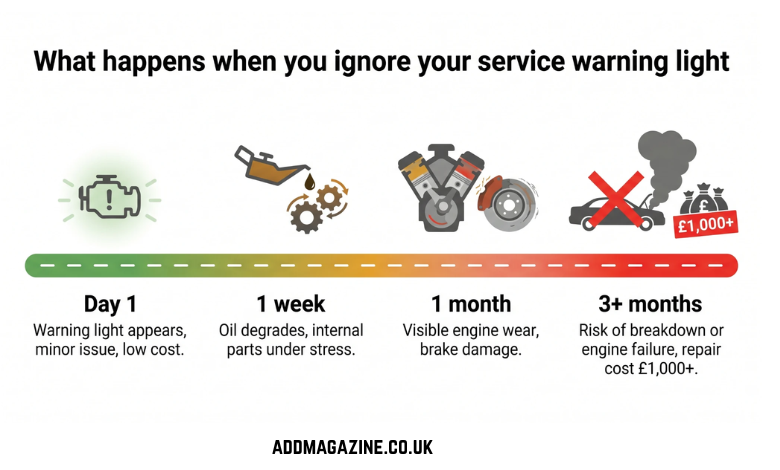
The timeline below shows how quickly a minor alert can escalate from a warning light on day one to a serious repair bill within months.
What the service warning light is actually telling you
The service warning light (sometimes called the maintenance reminder) is typically triggered by mileage intervals or time since your last service, whichever comes first. It is not always a sign of an emergency, but it is always a sign that scheduled maintenance is overdue. Some vehicles break this down into specific symbols: a spanner for general service, an oil can for lubrication issues, or a thermometer for temperature problems. Each one points to a different system, and each one deserves a prompt response.
How skipping an oil change quietly damages your engine
Engine oil degradation is one of the most predictable and most damaging consequences of a missed service. As AUTODOC quotes: : “Engine oil is a specially developed lubricant for internal combustion engines that plays an important role in the safe and efficient operation of motor vehicles. It performs several functions in the engine and contributes significantly to the lifespan and performance of the engine.”
In practice, this means oil does far more than just lubricate moving parts. It also carries heat away from the engine, cleans internal components, and protects metal surfaces from corrosion. Over time, heat and friction break down the oil’s chemical structure. Additives deplete. The oil thickens, or in some cases becomes too thin to form a proper film between engine components.
Once oil loses its protective properties, metal parts begin making direct contact with each other. In average driving conditions, this process accelerates significantly beyond the recommended oil change interval. The result can range from increased engine wear to, in serious cases, complete engine seizure a repair that is vastly more complex and costly than any routine service.
If you are unsure which oil your engine needs,AUTODOC UK online catalogue lets you search by registration plate or vehicle make filtering results to show only compatible products for your specific car.
Choosing the right oil matters too. Brands like Castrol, Mobil 1, Shell Helix, and Motul cover most modern engines, while Ridex a reliable own-brand line built to OE standards offers a cost-conscious alternative without cutting corners on specification. The key is matching the correct viscosity grade to your engine, which is always printed in the owner’s manual. For sourcing parts and fluids, AUTODOC has recently launched its marketplace directly in the UK, integrating local professional sellers into its platform. British customers now get access to over 1.2 million product listings spanning engine oils, filters, brake components, vehicle electronics and accessories with more competitive pricing and faster local delivery than before. All sellers on the platform are held to defined performance metrics, so the breadth of choice does not come at the expense of reliability.
Other things that go wrong when you delay a service
A missed service can also mean:
- Worn brake pads go undetected, eventually damaging the brake discs themselves a significantly more expensive repair
- Air filters become clogged, reducing engine efficiency and increasing fuel consumption
- Spark plugs degrade, causing misfires and poor starting especially noticeable in colder British winters
- Coolant levels and condition go unchecked, raising the risk of overheating in summer traffic
Each of these issues follows the same pattern: a small, manageable problem becomes a costly one because no one caught it at the right time.
Why waiting always costs more than the service itself
A routine service is one of the least expensive things you can do for your car. An engine replacement, a seized gearbox, or a set of damaged brake discs is not. The warning light is essentially your car asking for the cheaper option.
Drivers who stay on top of scheduled maintenance generally report fewer unexpected breakdowns, better fuel economy, and higher resale values. These are not coincidences they are the direct result of catching problems early.
If your service light is on right now, the best step is straightforward: book a service or check your oil level and condition today. Waiting another week rarely saves money. It almost always costs more.
Sources: Data on UK driver behaviour from an Autotrader/Censuswide survey of 1,000 UK drivers (February 2026); AUTODOC product and marketplace information sourced directly from AUTODOC official materials (2026).
FAQ
What happens if you keep driving with a service warning light on? The longer you leave it, the worse the damage. Oil degrades, brake pads wear down undetected, and what starts as a minor issue can end in engine failure or a breakdown repairs that far outweigh the cost of a routine service.
How do I know which engine oil is right for my car? Check your owner’s manual for the correct viscosity grade. If you are unsure, AUTODOC’s online catalogue lets you search by registration plate and filters results to show only oils compatible with your specific vehicle.










Post Comment