Strategic Impact of Gen AI in Modern IT
Introduction
Generative artificial intelligence is reshaping the role of IT across the enterprise. What was once viewed as an experimental capability has quickly become a strategic priority for CIOs and technology leaders. Organizations are exploring how Gen AI can improve productivity, enhance service delivery and support innovation at scale.
As enterprises modernize their technology landscape, Gen AI is increasingly embedded within broader transformation agendas. Many organizations are aligning AI initiatives with enterprisewide digital programs, including structured Digital Transformation Services that focus on operating model evolution, cost optimization and performance improvement.
However, successful adoption of Gen AI in IT requires more than tool deployment. It demands governance, measurable performance targets and alignment with business strategy. This article examines how Gen AI is transforming IT, outlines key benefits and use cases, and explains why a benchmark-driven approach is critical for long-term success.
Overview of Gen AI in IT
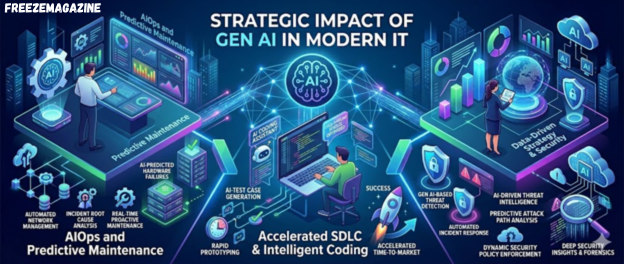
Gen AI refers to advanced AI models capable of generating text, code, analytics summaries and recommendations based on patterns learned from large datasets. In IT organizations, these capabilities extend well beyond conversational interfaces. They influence software engineering, IT operations, cybersecurity, enterprise architecture and service management.
Public insights from The Hackett Group® emphasize that Gen AI has significant potential to increase IT productivity by automating knowledge-intensive tasks. Rather than replacing skilled professionals, Gen AI augments their capabilities, enabling teams to focus on higher-value strategic initiatives.
Within IT functions, Gen AI can support:
- Code generation and refactoring
- Automated testing support
- Incident summarization and root cause analysis
- Infrastructure configuration assistance
- Log and performance data analysis
- Documentation drafting and knowledge management
The effective deployment of Gen AI in IT requires structured governance and integration with enterprise architecture standards. Organizations that treat AI as part of a disciplined transformation roadmap, rather than isolated pilots, are better positioned to achieve scalable and sustainable results.
Benefits of Gen AI in IT
Improved productivity across IT functions
Gen AI enhances efficiency in both development and operations. Developers can use AI-powered tools to generate repetitive code elements, identify potential vulnerabilities and accelerate debugging processes. IT operations teams can automate routine documentation and knowledge retrieval tasks.
By reducing manual effort, Gen AI enables IT professionals to dedicate more time to innovation, solution design and strategic planning.
Faster, data-driven decision-making
Gen AI can analyze this data and generate concise summaries, recommendations and forecasts.
IT leaders can use AI-generated insights to optimize capacity planning, prioritize investments and align technology initiatives with business objectives.
Enhanced service quality and responsiveness
In IT service management, Gen AI improves ticket triage and resolution processes. AI-driven assistants can categorize incidents, suggest solutions and draft responses based on historical patterns.
These capabilities reduce resolution times and improve user satisfaction. Consistency in communication and documentation also strengthens service governance.
Cost optimization and resource efficiency
Gen AI can help identify inefficiencies in infrastructure utilization, licensing and support processes. By automating repetitive tasks and improving analytical accuracy, organizations can reduce operational costs and minimize rework.
Improved forecasting and capacity planning further enhance financial discipline within IT.
Strengthened risk and compliance management
Gen AI can assist with reviewing system logs, drafting policy documentation and identifying anomalies that may signal security or compliance risks. By augmenting governance and cybersecurity teams, AI improves monitoring and response capabilities.
Responsible deployment, supported by clear policies and oversight, is essential to managing data privacy and intellectual property considerations.
Use cases of Gen AI in IT.
Software development and engineering
Code generation and review
Gen AI tools can generate code snippets, recommend optimizations and assist with peer reviews.
Automated documentation
Maintaining accurate technical documentation is a persistent challenge. Gen AI can summarize repositories and generate structured documentation, ensuring consistency across projects.
IT service management
Intelligent ticket categorization
Gen AI can analyze incoming service requests, classify issues and recommend potential resolutions. This reduces manual triage and enhances first-contact resolution rates.
Knowledge base augmentation
AI-powered assistants can extract relevant information from internal knowledge repositories and provide contextual responses to IT staff and end users.
Infrastructure and cloud management
Capacity forecasting
By analyzing performance metrics and usage patterns, Gen AI can generate capacity forecasts and suggest adjustments.
Configuration automation
Gen AI can draft configuration templates and deployment scripts, improving standardization across hybrid and cloud environments.
Cybersecurity operations
Threat intelligence analysis
Gen AI can summarize threat intelligence feeds and analyze security logs to identify unusual patterns. This accelerates incident detection and response.
Policy drafting and updates
Security teams can use AI to draft and refine policies aligned with regulatory requirements and evolving risk landscapes.
Enterprise architecture and strategy
Scenario modeling
Gen AI can assist architecture teams in modeling technology scenarios and summarizing trade-offs. This supports informed investment decisions.
Application portfolio analysis
By reviewing application inventories and usage data, Gen AI can identify redundancies and modernization opportunities.
Why choose The Hackett Group® for implementing Gen AI in IT
Adopting Gen AI at scale requires a disciplined, benchmark-driven approach. The Hackett Group® is recognized for its research-based insights and Digital World Class® performance framework, which helps organizations align technology initiatives with measurable outcomes.
Benchmark-informed prioritization
The Hackett Group® leverages extensive benchmarking data to identify performance gaps and prioritize high-impact Gen AI use cases. This ensures investments are tied to business value rather than isolated experimentation.
Governance and risk management expertise
Gen AI introduces considerations related to data governance, security and ethical use. A structured framework helps organizations deploy AI responsibly while maintaining compliance and minimizing risk.
Integrated transformation alignment
Rather than treating Gen AI as a standalone initiative, The Hackett Group® integrates AI into broader enterprise transformation programs. This ensures alignment with operating models, financial objectives and strategic priorities.
Practical implementation support
From opportunity assessment to pilot execution and enterprise scaling, organizations receive practical guidance grounded in measurable benchmarks. Change management and capability development are central to long-term adoption.
The Hackett AI XPLR™ platform further enables organizations to explore, evaluate and prioritize AI use cases across business functions. It provides structured insights that help leaders move from experimentation to disciplined deployment.
Conclusion
Gen AI is reshaping the IT function by enhancing productivity, accelerating decision-making and improving service quality. When aligned with enterprise strategy, it supports cost optimization, risk management and digital modernization.
However, realizing these benefits requires more than adopting new tools. Organizations must establish governance frameworks, define measurable outcomes and integrate Gen AI into structured operating models.
As enterprises continue to modernize their technology environments, Gen AI will play an increasingly central role in shaping IT performance. With a disciplined, benchmark-driven approach, organizations can strengthen IT’s strategic impact and deliver sustainable business value.








Post Comment