LED Lighting for Car Dealerships: Transform Sales and Cut Costs
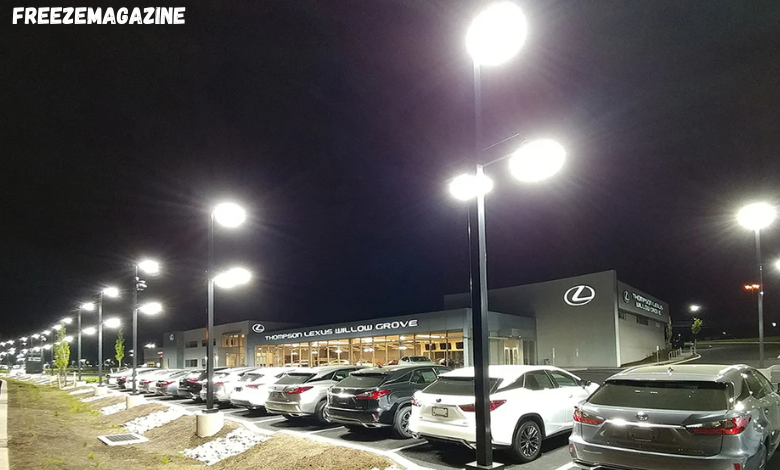
Customers decide within seconds. They judge vehicle quality by appearance. Poor lighting makes good cars look damaged. Bright lighting makes every car sell faster.
Traditional metal halide bulbs produce yellow tones. They distort vehicle colors. Customers see one color at the dealership. They see a different color at home. They return the car. The deal fails.
LED Lighting for Car Dealerships renders true colors. They match daylight. Customers see exactly what they’re buying. Confidence increases. Sales close faster.
Why this matters for your dealership:
- Customers trust accurate color display
- Paint appears richer and more vibrant
- Interior fabrics show true tone
- Metallic finishes shine correctly
- No buyer’s remorse from color surprises
- Higher customer satisfaction ratings
Visibility Creates Safety and Security
Dark lots attract criminals. Thieves target invisible inventory. Damaged cars hide in shadows.
Bright lighting prevents theft. Security cameras work better. Police respond faster to lit areas. Customers feel safe browsing at night.
A single break-in costs thousands. Insurance premiums increase. Reputation damage spreads fast. One well-lit parking lot prevents years of losses.
Security benefits that protect your business:
- Theft decreases significantly
- Security cameras capture clear facial images
- Employees feel safer working late shifts
- Customers browse confidently after dark
- Police prioritize well-monitored areas
- Insurance companies offer premium discounts
Energy Bills Drop 60-70 Percent
A dealership with 80 outdoor lights running 12 hours daily pays $40,000+ annually for electricity. That’s with old metal halide fixtures.
LED lights use one-third the power. Same brightness. One-third the cost.
$40,000 drops to $12,000. That’s $28,000 saved annually. Over 10 years, that’s $280,000.
Maintenance costs disappear too. LED bulbs last 50,000 hours. Metal halide bulbs last 10,000 hours. Technicians replace bulbs 5 times fewer.
Ballasts fail constantly in traditional systems. Each ballast replacement costs $500-$1,000 in labor and parts. LEDs have no ballasts. That problem vanishes.
Real cost comparison for typical dealership:
- Electricity: Save $20,000-$30,000 yearly
- Bulb replacements: Save $3,000-$5,000 yearly
- Ballast repairs: Save $2,000-$4,000 yearly
- Technician labor: Reduce by 80 percent
- Total annual savings: $25,000-$39,000
Showroom Lighting Showcases Inventory
Showroom customers spend 20-30 minutes examining vehicles. Lighting quality during those minutes determines purchase decisions.
Shadows under cars suggest damage. Uneven lighting implies problems. Bright, consistent light builds confidence. It shows the dealership maintains standards. It proves management cares about presentation.
Color temperature matters. 4000K lights display colors naturally. They match outdoor daylight. Customers see the same vehicle color outside that they saw inside. No surprises. No returns.
Poor showroom lighting costs sales. Better lighting increases closing rates. The investment pays for itself monthly.
Showroom lighting impact:
- Eliminates shadows that suggest hidden damage
- Maintains consistent brightness across all vehicles
- Displays true colors in daylight equivalent
- Reduces customer hesitation and questions
- Increases purchase confidence
- Improves closing rates measurably
Service Department Efficiency Increases
Mechanics work under poor lighting and make mistakes. They miss problems. They work slower. Repairs take longer.
Bright LED lights reduce errors. Technicians see small components clearly. They work faster. Quality improves.
Fewer mistakes mean fewer comebacks. Fewer comebacks mean happier customers. Happy customers return for service. Service department revenue increases.
Good lighting also keeps staff longer. Eye strain causes headaches. Headaches cause people to quit. Better lighting improves employee retention. Training new technicians costs $5,000+. Keeping existing staff is cheaper.
Service bay benefits:
- Technicians spot problems faster
- Repair quality improves measurably
- Work time decreases
- Fewer comeback repairs needed
- Employee retention increases
- Staff productivity rises
Outdoor Lot Lighting Matters Most
Outdoor lighting is visible 24/7. It’s the first thing customers see. It creates initial impressions. Dark lots look abandoned. Bright lots look successful.
Proper spacing prevents dark zones. Taller poles reduce fixture count. Lower poles increase coverage but cost more. The balance matters.
50-100 outdoor fixtures are typical. That’s where electricity costs dominate. That’s where LED savings are biggest.
Perimeter lighting serves security. Entrance lighting guides customers. Display row lighting showcases premium inventory. Each area needs different intensity.
Outdoor lighting strategy:
- Main lot: 30-40 lux brightness
- Premium inventory rows: 50-60 lux brightness
- Entrances: 75-100 lux brightness
- Perimeter: 40-60 lux brightness for security
- Spacing: 40-50 feet between poles typical
Rebates and Incentives Reduce Costs
Most utility companies offer LED rebates. They want to reduce peak demand. They offer money to switch.
Rebates typically cover 25-40 percent of installation costs. A $50,000 project becomes $30,000 after rebates.
Some utilities offer time-of-use incentives. Lighting outdoor lots qualifies often. Applications take 30 minutes. Rebate approval takes 2-4 weeks. Money arrives after installation.
Government tax credits exist too. They’re less common but valuable when available. Check with your accountant.
Finding available incentives:
- Contact your local utility company first
- Ask about commercial LED programs
- Request rebate amounts per fixture type
- Check state energy office website
- Consult your tax professional
- Apply before purchasing fixtures
Installation Timing and Disruption
Retrofits use existing poles. No foundation work needed. Installation takes 2-4 weeks. The dealership stays open normally. Sales continue. No disruption.
Complete replacement takes longer. New poles need concrete foundations. Trenching requires permits. The project takes 6-12 weeks. Planning matters.
Phased installation spreads costs. Upgrade showroom first. Customers see improvement immediately. Then upgrade the lot. Finally upgrade service areas.
Phased approach also allows measuring results. LED fixtures in the showroom boost sales numbers. Document the improvement. Use data to justify phase two budget.
Installation considerations:
- Retrofits: 2-4 weeks, no major disruption
- New installation: 6-12 weeks, plan accordingly
- Permits required for outdoor work
- Concrete curing takes 7 days minimum
- Phased approach spreads costs and disruption
- Document results after each phase
Fixture Selection Matters
All LED fixtures aren’t equal. Budget fixtures fail within 5 years. Quality fixtures last 10+ years.
Color rendering index (CRI) should be 90+. Lower CRI distorts colors. This matters for vehicle display.
Dimming capability allows flexibility. Dim lights at 2am when no customers browse. Full brightness during evening shopping hours. Controls reduce electricity 15-30 percent.
Weather-resistant design is mandatory outdoors. Cheap fixtures corrode. Quality fixtures withstand salt, humidity, and temperature swings.
Essential fixture specifications:
- CRI 90+ for accurate colors
- IP65 rating for outdoor weather resistance
- 50,000+ hour lifespan
- Dimming capability built-in
- 5-year minimum warranty
- Certification by independent labs
Color Temperature Selection
4000K is neutral. It matches daylight. It displays colors accurately.
3000K is warm. It creates comfort. Use in customer waiting areas only.
5000K is cool. It emphasizes whites. Use in service areas. Technicians see details clearly.
Never mix color temperatures. Uneven light confuses customers. It looks unprofessional. Stick to one temperature throughout outdoor areas. Choose different temperature for indoor offices only.
Color temperature guide:
- Display areas: 4000K (neutral daylight)
- Service bays: 5000K (cool, detail-revealing)
- Customer waiting areas: 3000K (warm, comfortable)
- Showroom: 4000K (accurate colors)
- Outdoor lot: 4000K (professional appearance)
Maintenance Drops Dramatically
LEDs need no maintenance. Traditional bulbs need replacement every 6-12 months. That’s a technician climbing ladders. That’s a truck, fuel, labor, and new bulbs.
LEDs last 50,000 hours. That’s 6-10 years typically. Maintenance drops to nearly zero.
Fixtures stay cleaner too. LEDs produce less heat. No thermal cycling. Lenses don’t yellow. Brightness remains constant for years.
Compare costs. Replace 100 bulbs twice yearly at $50 labor each. That’s $10,000 annually. LEDs eliminate that cost.
Maintenance cost breakdown:
- Traditional system: $10,000-$15,000 yearly
- LED system: $500-$1,000 yearly
- Savings: $9,000-$14,000 yearly
- Over 10 years: $90,000-$140,000 saved
Make Your Decision
LED lighting for car dealerships saves money. It increases sales. It improves security. It reduces maintenance. The decision is clear.
Start with a professional lighting assessment. Calculate your current electricity costs. Request rebate information from your utility company. Compare fixtures on quality, not price alone.
The cheapest option costs most long-term. The best option costs least long-term. Quality LED fixtures pay for themselves in 2-3 years.
Your competitors may not have upgraded yet. Moving now gives you an advantage. Better lighting means better sales. Better sales mean better profit margins.
Track results carefully. Document electricity savings monthly. Note improved closing rates. Show return on investment clearly. This builds support for future improvements.
LED lighting for car dealerships isn’t just about brightness. It’s about creating an environment where customers buy faster. Where staff works better. Where costs drop. Where profits increase.
That’s the real value proposition.


Post Comment