CNC Turning Optimization: An advanced manufacturing process that enhances efficiency, cutting aerospace component costs by 40%
Introduction
The aerospace industry’s insatiable appetite for innovation is rivaled only by their demand for precision in the finished product. However, the customary process has led to not only high costs but it has delayed many projects as well. The cost, timeline, and precision of the finished project directly affect mission-critical project schedules. Often, the process has encountered problems like suboptimal selection of raw materials and machining techniques. Furthermore, navigating the seemingly conflicting demands of precision and cost effectiveness within the customary process is not easy.
The article here below delves into the use of aluminium CNC turning in directly solving the challenges in the aerospace industry. The subsequent sections aim to give a deeper insight into Aluminium CNC Turning and its use in solving the challenges in the aerospace industry itself.
What is CNC Turning and Its Key Role in Precision Manufacturing?
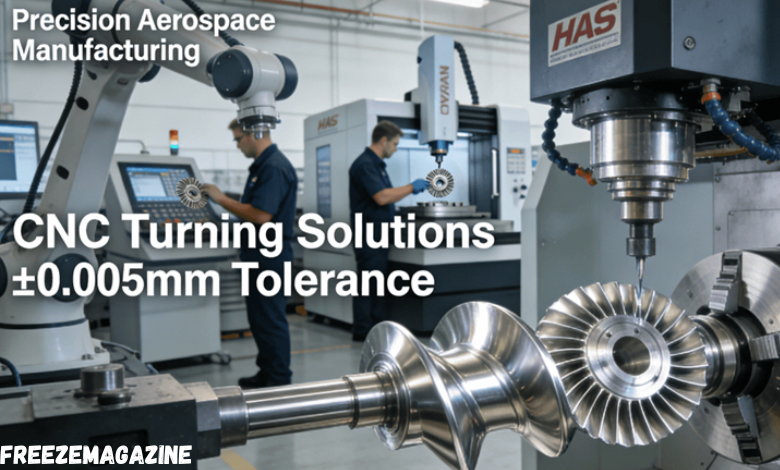
CNC turning is a basic subtractive process for Precision Manufacturing Technology, whereby a tool is used to cut material from a revolving part, thus creating a part which is cylindrical or conical. Clearly, turning is an important part of contemporary Precision Manufacturing Technology, used for generating accurate parts such as axles, bushings, and bolts, all while ensuring a high level of consistency. As may be expected, the entire turning process commences by generating a computerized design, which can be used to generate required operations (G-code).
The major benefit related to the technology is the capability to hold tight tolerances, often as low as ± 0.005mm, which is vital in the production of aircraft where the final fit is critical to the proper working dimensions. Basically, the technology reduces human failure, thus ensuring faster project completion due to the automated features incorporated into the manufacturing process. The International Organization for Standardization’s (ISO) standards, such as the ISO family related to standardization (ISO 9001), draw attention to the importance related to standardization in the manufacturing direction. It is this synergy of automation, precision, and standardization that has made CNC turning an indispensable pillar of advanced manufacturing.
How to Select Suitable Aluminum Materials to Optimize CNC Turning Part Performance?
The selection of an appropriate aluminum alloy is a critical decision with a direct impact on component performance, longevity, and cost. Various types of alloys have different strengths in combinations of factors such as machinability, corrosion resistance, and strength.
Analyzing Some of the Most Common Aluminum Alloys Used in CNC
Another commonly used material in the aerospace world is CNC 6061 aluminum, prized particularly because it has good overall mechanical properties. It has good weight-to-strength ratings, is easily machined, can be welded, and can be used in many different structural applications. Should higher strengths be necessary, however, 7075 series materials tend to be the way to go, though these may be more difficult to machine. The selection must be done in consideration of the application’s needs, including any possible extreme temperature or pressure demands.
Key Selection Criteria and Practical Recommendations
When optimizing the design for aluminium CNC turning parts, there are several factors to be taken into consideration.
- Evaluating Mechanical and Physical Properties
Key characteristics cover tensile strength, hardness, and thermal conductivity. To exemplify, for design elements subject to intense dynamic loading, required material characteristics involve a strong fatigue strength. Data from sources like the NASA Technical Reports Server provide invaluable data on material integrity to meet aerospace conditions while ensuring compliance with stringent safety regulations.
- Common Selection Blunders to Shun
One of the most common mistakes is focusing entirely on end strength rather than machinability. This alloy, though stronger due to its increased hardness, could end up with increased tool wear and therefore increased machinability costs. It is therefore important to seek advice from manufacturing engineers at the design stage of an application with regard to material machinability. One of the most important credentials of any given firm is its certifications, such as ISO 9001. For a detailed analysis of some of these trade-offs, a comprehensive Aluminium CNC Turning guide would certainly provide deeper insights.
The Role of Supplier Certification in Material Integrity
With the use of suppliers who implement robust quality management systems, the raw material is manufactured to specified standards; it allows traceability and ensures the integrity of the aluminium CNC turning parts right from the start.
CNC Turning for Aerospace Component Manufacturing-D Case Studies
‘Industry Case Studies’ provide the best way to understand how the practical application of CNC turning in aerospace is done. In one such well-known case, a satellite manufacturer encountered weight and cost problems with its reaction wheel assemblies, which included high-precision components tolerancing less than ±0.01mm and made from a lightweight material with high strength.
The solution was to manufacture the complex housings from a solid block of 6061-T6 aluminum using 5-axis Aluminium CNC Turning. This approach enabled the integration of numerous formerly separate parts into one monolithic component, thereby eliminating assembly steps and potential failure points. Furthermore, strict Manufacturing Quality Control protocols, including in-process inspections with coordinate measuring machines, ensured every part would meet the exacting specifications. This case exemplifies how advanced CNC turning directly enhances both performance and efficiency for Aerospace Components. For example, a manufacturer like JS Precision, accredited to AS9100D, epitomizes the quality systems needed to realize such highly reliable outcomes.
Enhancing Precision and Reliability in CNC Turning through Stringent Quality Control
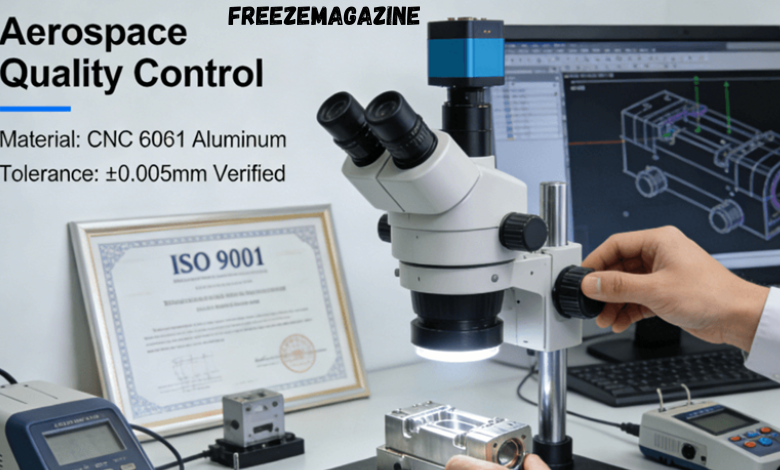
Quality engineer inspecting CNC turned aluminum parts using precision measurement equipment
However, the maintenance of high precision during the process in the turning machine is not possible without the proper framework of quality control (QC), since it extends throughout the manufacturing process itself.
Implementing a Multi-Stage Quality Control System
A comprehensive QC system involves several checkpoints to ensure consistency and reliability for every custom CNC aluminum part produced.
- In-Process and Final Inspection Techniques
In-process inspection involves checking the product at every stage. For example, computer-based instruments, such as micrometers, calipers, or comparators, can be incorporated. Before the product finally leaves the shop, final inspection occurs. This involves highly developed Coordinate Measuring Machines, ensuring that the product’s dimensions are within the tolerances, making the product perfect.
- Adherence to International Standards
Quality standards as set by organizations like the ‘European Space Agency (ESA)’, which manufacture aerospace components, offer a measure of quality. Quality certifications like ISO 14001, which refers to Environmental Management, and IATF 16949, which refers to Automotive Quality, may seem like different standards but determine the degree to which the company has control measures in place, ensuring smoother processes, which equates to higher reliability. Any company that provides an aluminum CNC machining service that is based on these standards minimizes the risk of defect.
Impact of Process Certification on Process Reliability
A certification scheme offers an auditable structure, whereby everything, starting with the programming and moving on into the post-processing, can be controlled, repeatable, and above all, reliable, such as in the field of aerospace.
The Future of CNC Turning in Medical Device Development
While transformative in aerospace, the principles of precision CNC turning are similarly revolutionary in Medical Device Development. Automation and specialized material use will continue to play a larger part in the future. The trend toward minimally invasive surgical tools, along with patient-specific implants, raises the bar on the machining of extremely complex geometries from bio-compatible materials like titanium and specialty stainless steel alloys.
Advanced CNC turning centers featuring live tooling combined with automation will be able to produce these complex components in high volume with the required precision and surface finish. Being able to rapidly prototype using the same technology that will go into production speeds up the development cycle to rapidly iterate and achieve regulatory approval faster. The experience from manufacturing high-reliability aerospace components, such as optimizing designs for aluminum CNC machining service, directly flows to the medical field where failure is not an option. The cross-pollination of technology and quality standards will continue to drive innovation in life-saving medical devices.
Conclusion
In conclusion, aluminium CNC turning technology overcomes crucial manufacturing problems in high-hazard industries such as aeronautics and medical equipment. By carefully choosing materials such as CNC 6061 aluminum, putting in place strict Manufacturing Quality Control systems, and embracing tried-and-tested methodologies from ‘industry case studies’, the manufacturer will be able to achieve unparalleled levels of accuracy, productivity, and economy. From design through to faultless finished component, the journey requires the input of an apt and certified supplier. If this information has helped provide further insight into solutions for custom requirements or for more technical resources to better understand your needs for your next projects, please feel free to take action now by contacting a professional supplying service.
Biography of the Author
The author is a precision manufacturing specialist with over a decade of experience in the research and application of CNC turning technology. With the involvement of taking part in multiple international projects, his commitment to the development of innovation and knowledge sharing in manufacturing industries is his concentration.
FAQ Section
Q1: What are the main advantages of CNC turning?
A: CNC turning excels at producing high-precision rotational parts like shafts and sleeves, significantly improving production efficiency and minimizing material waste for industries like aerospace and medical devices.
Q2: How to choose suitable aluminum for CNC turning?
A: Selection issues could include the needed strength of the cable tie itself, weight constraints, and cost. Examples of cable ties include 6061 aluminum, which provides a cost/performance compromise between machinability and robust dimensions. Consult a professional if you’re unsure about the solution to best fit the problem.
Q3: Does CNC turning work for complex geometries?
A: Yes, today’s multi-axis CNC turning centers can create these sort of complicated shapes. However, even to attain the best precision, proper design optimization may be required, often accomplished via computer simulation programs like CAD/CAM.
Q4: What is the method of quality control in CNC turning?
A: Quality is sustained by in-process inspection as well as end product verification with equipment such as CMM, in a setting governed by appropriate levels of ISO certification to ensure that parts are within critical tolerance levels, keeping defects at minimum probability.
Q5: What is the usual lead time for CNC turning?
A: A lead time of 1 or 2 weeks is standard, depending on part complexities and order quantity. RPD can often provide faster delivery, where lead time is in terms of days rather than weeks.






Post Comment