Chatbot vs Virtual Assistant: 5 Key Differences to Consider
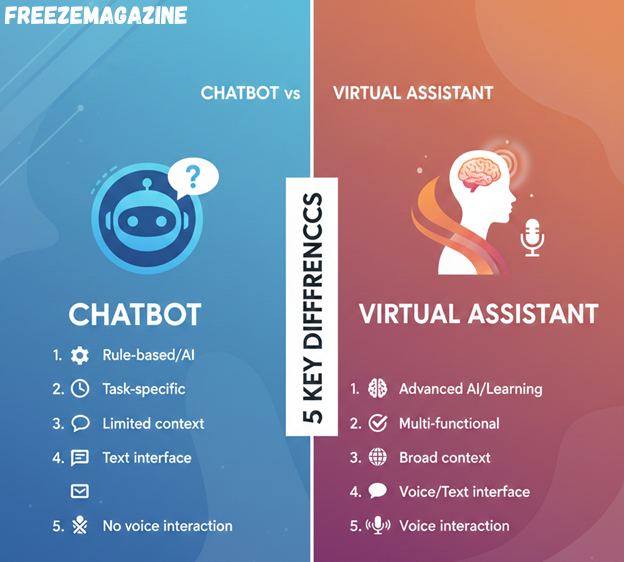
You have probably seen both terms everywhere. Chatbot. Virtual assistant. They sound similar. But they are not identical. Choosing the wrong one for your business can slow growth and confuse customers. If you want smarter automation, you need to understand the difference clearly. A chatbot may answer questions on your website. A virtual assistant may handle tasks across tools and devices. Both are useful. But they serve different goals. Let us break it down in simple terms.
Understand the Basics
Before comparing features, we need to define each tool clearly.
It usually works inside websites, apps, or messaging platforms. It answers questions. It guides users. It collects information. Many businesses use an AI Chatbot for Customer Support to handle common inquiries and reduce workload.
A virtual assistant usually connects with many devices and tools. It can schedule appointments, create reminders, and control smart systems. Its function is broader than simple chat, and it may operate using voice.
In short, chatbots focus on conversations within a specific channel. Virtual assistants often handle tasks across environments.
5 Key Differences You Must Know
Below are five clear differences between a chatbot and a virtual assistant. Each difference matters when deciding what your business needs.
1. Purpose and Scope
A chatbot is built mainly for conversation. It answers questions and supports users inside a website or app. A virtual assistant often handles wider tasks like scheduling, file management, or device control. Its scope is usually larger.
2. Deployment Environment
Chatbots are commonly embedded into websites or messaging apps. They live inside a specific channel. Virtual assistants can operate across devices, including phones and smart speakers. They are not limited to one interface.
3. Complexity and Integration
Chatbots are simpler to launch. Many tools provide a Conversational AI Platform that helps businesses build bots without complex coding. Virtual assistants often require connections with several tools and systems.
4. Interaction Style
Chatbots mainly use text to communicate. Some include voice features, but typing remains the main method. Virtual assistants are commonly voice-driven and respond to spoken instructions.
5. Business Focus
Chatbots are commonly used for lead generation, FAQs, booking, and support. They help reduce response time and improve engagement. Virtual assistants may focus more on personal productivity or enterprise-wide task automation.
These five differences make it clear that the two tools serve related but separate roles.
Quick Comparison Table
Below is a simple summary to make the differences easy to see.
| Feature | Chatbot | Virtual Assistant |
| Primary Role | Conversational support | Task automation |
| Channel | Website or messaging | Cross-device |
| Setup | Easier with builders | More complex |
| Interaction | Mostly text-based | Often voice-based |
| Business Use | Support and engagement | Broader operations |
When Should You Choose a Chatbot?
If your goal is better customer interaction, faster replies, and improved engagement, a chatbot is often the right choice. Businesses use chatbots to answer common questions, guide users through products, and collect contact details. They help reduce wait times. They also scale easily. Whether ten users ask questions or one thousand, response speed remains steady.
Modern AI-powered chatbots also provide analytics. They show conversation trends. They reveal what users ask most. This helps improve content and service over time.
For example, platforms like GetMyAI allow companies to deploy intelligent chat systems that focus on website and messaging support. These systems improve communication without replacing human teams.
If your priority is customer-facing interaction, a chatbot is often enough.
When Is a Virtual Assistant the Better Fit?
If your needs go beyond customer conversation, a virtual assistant may be more suitable.
Virtual assistants can connect with calendars, email systems, and internal workflows. They help manage tasks and improve productivity. In enterprise settings, they may assist employees rather than customers.
But this approach often requires stronger system integration and more time to set up. It may also demand higher costs and technical skills. For this reason, many companies begin with chatbots instead. They solve immediate customer needs without heavy infrastructure changes.
Common Mistakes to Avoid
But excitement without clarity can lead to poor decisions. Many businesses jump straight into complex systems without asking what they truly need. They assume bigger tools mean better results. That is not always true. Sometimes, simple solutions work best. The problem is not the technology. It is the lack of direction. Before choosing any solution, step back and ask what problem you are solving. Clear goals protect you from wasted time and money.
Here are five common mistakes to watch for:
- Selecting complex systems without a clear plan
- Ignoring chatbot training and careful testing
- Believing automation fixes everything
- Forgetting to define your goals early
- Hoping for results without steady improvement
Success begins with clarity.
The Future of Conversational Technology
Technology never stands still. What feels advanced today becomes normal tomorrow. Chat tools are growing smarter each year. They now understand questions better. They read intent, not just words. They give replies that feel more natural and more personal.
At the same time, virtual assistants are expanding their reach. They manage schedules. They control systems. They connect with business tools and devices. Their role is becoming wider and more powerful inside modern workplaces.
Yet the difference between the two is clearer than ever. Chatbots work best inside specific channels where they lead conversations. Virtual assistants take care of wider tasks across connected systems. When you know this, you can decide wisely and create smarter digital plans.
Conclusion
Chatbots and virtual assistants may sound alike, but their roles are different. A chatbot focuses on conversation within a platform. A virtual assistant often manages tasks across systems. If your goal is to improve engagement and reduce support workload, an AI Chatbot is often the practical starting point. With tools like an AI Chatbot Builder, businesses can deploy smart conversation systems quickly and efficiently. Choosing the right solution depends on your objective. Keep it simple. Match the tool to the task. And build technology around real business needs, not trends.







Post Comment